
The interim report of the Independent Review into Mental Health Conditions, ADHD and Autism fails to address FASD
The Department of Health and Social Care has published the “Independent Review into Mental Health Conditions, ADHD and Autism: Interim Report” (March 2026).
This report does not yet name FASD (Fetal Alcohol Spectrum Disorder) as a driver or lens for the identified “rising distress” and “growing difficulty” in the related services – and National FASD considers that is a material gap.
Government says it’s not their responsibility
Lord Adebowale raised this gap in a recent question put to the Department of Health and Social Care. “To ask His Majesty’s Government, in light of the interim report of the Independent Review into Mental Health Conditions, ADHD and Autism, published on 31 March, whether the final report of the Review will address the evidence on Foetal Alcohol Spectrum Disorder and the neurodevelopmental consequences of prenatal exposure to alcohol and other substances, including the misidentification of these conditions as ADHD or autism; and if not, why not.”
The Government’s response from Baroness Merron avoided responsibility for this ommission. She wrote, “The review is independent of the Government, and it is for the chair and vice chairs to determine the specific issues the review considers.” The answer highlights the stakes at play, “The final report, due in the summer, will make recommendations on how the Government, the health system, and wider public services can respond to increasing demand for support more fairly and effectively so that people receive the right support, at the right time, in the right place.”
National FASD spotlights why FASD must be considered in this Review
In a new policy brief National FASD points out that the Independent Review will miss some of the most vulnerable children and young people if it does not explicitly consider FASD.
National FASD’s Chief Executive Sandra Butcher says, “The fact that this Review committee has consciously chosen to ignore the impact of prenatal alcohol exposure and FASD is staggeringly short-sighted, goes against NICE and DHSC guidance and dooms the reforms to fail to have the intended impact. People with FASD are already in these services – with and without diagnosis – and they are the people for whom traditional interventions are not working. Doing more of the same and failing to consider this group despite the high prevalence of overlap would be a waste of time and money and will come at great cost to the very people this Review is meant to help. There’s still time to fix this.”
A core principle of the UK FASD Manifesto, written with input from more than 60 people with FASD saysm “Treat us with the same respect as others,” and “Listen to us.”
Currently the Independent Review into Mental Health Conditions, ADHD and Autism is doing neither.
National FASD's new policy brief explores what's at stake and why this is important
Key points from the policy brief:
FASD is more common than autism and is heavily over‑represented among care‑experienced, traumatized, justice‑involved young people and those with extensive school exclusion histories.
Yet, FASD is rarely diagnosed and is often mislabelled as ADHD, autism, “behavioural problems” or attachment issues. A sizeable fraction of those presenting with “complex ADHD”, “complex autism”, emotional dysregulation or multiple psychiatric diagnoses have underlying FASD. Even when it is diagnosed, appropriate professionals are unaware of the import of that diagnosis. In fact, failure to recognise and address FASD can increase risk for mental health challenges among some of society’s most vulnerable.
Ignoring FASD means that a biologically driven, preventable contributor to ADHD‑ and autism‑like presentations is left out of the explanatory framework, and the highest‑need subgroup inside today’s ADHD/autism/mental health caseloads is treated as invisible.
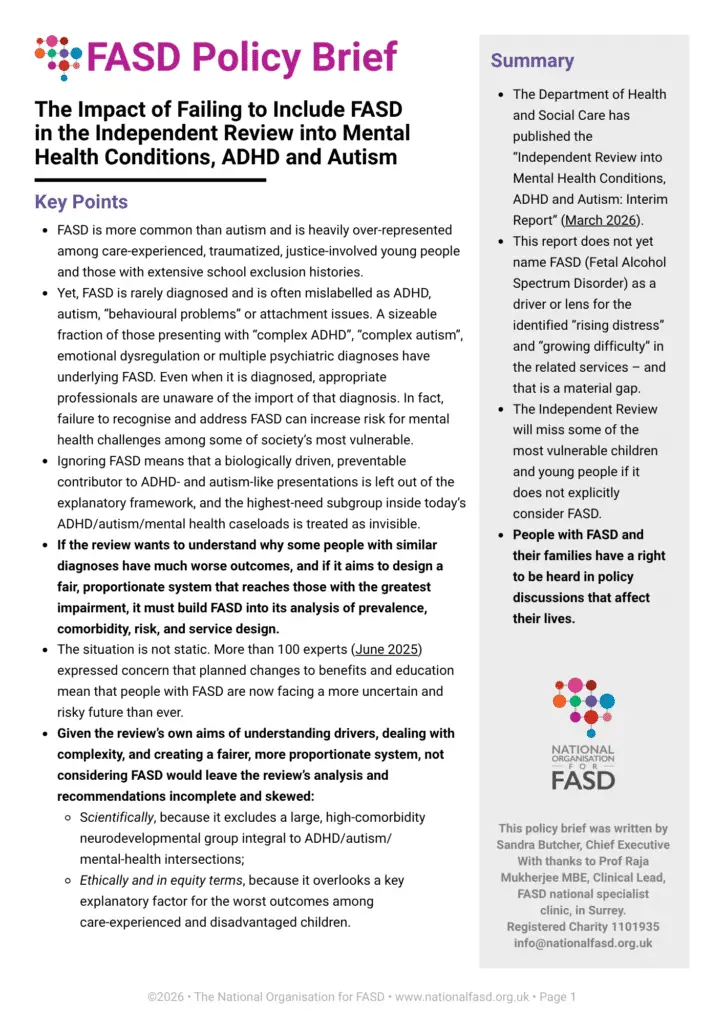
If the review wants to understand why some people with similar diagnoses have much worse outcomes, and if it aims to design a fair, proportionate system that reaches those with the greatest impairment, it must build FASD into its analysis of prevalence, comorbidity, risk, and service design.
The situation is not static. More than 100 experts (June 2025) expressed concern that planned changes to benefits and education mean that people with FASD are now facing a more uncertain and risky future than ever.
Not considering FASD would leave the review’s analysis and recommendations incomplete and skewed
Scientifically, because it excludes a large, high‑comorbidity neurodevelopmental group integral to ADHD/autism/ mental‑health intersections;
Ethically and in equity terms, because it overlooks a key explanatory factor for the worst outcomes among care‑experienced and disadvantaged children.
Why that matters
Dimension | Review focus | What FASD evidence adds | Why omission matters |
Scope | Prevalence and support for mental health, ADHD, autism | FASD is common, with prevalence rate higher than autism | A major neurodevelopmental condition is absent |
Drivers of rising diagnoses | Distress, awareness, thresholds, service pressures | Prenatal alcohol exposure as an aetiological driver for some cases | Misses preventable, biologically rooted contributors |
Comorbidity | Plans to look at multiple conditions in next phase | FASD commonly co‑occurs with ADHD, ASD, mental illness | High‑need subgroup inside cohorts is unrecognised |
Equity focus | Children, young people, those out of education/work | FASD concentrated in care‑experienced and justice‑involved groups | Most vulnerable children fall through analytic and policy gaps |
System design | Earlier, better‑matched, proportionate support | FASD requires adapted assessment, formulation and intervention | Risk of designing pathways that don’t work for those with FASD |
The bottom line:
If the Independent Review into Mental Health Conditions, ADHD and Autism is serious about understanding why some children and adults with ADHD, autism and mental health diagnoses struggle so profoundly despite contact with services, and if the point of the review is to design equitable, joined‑up support, then FASD cannot be ignored.