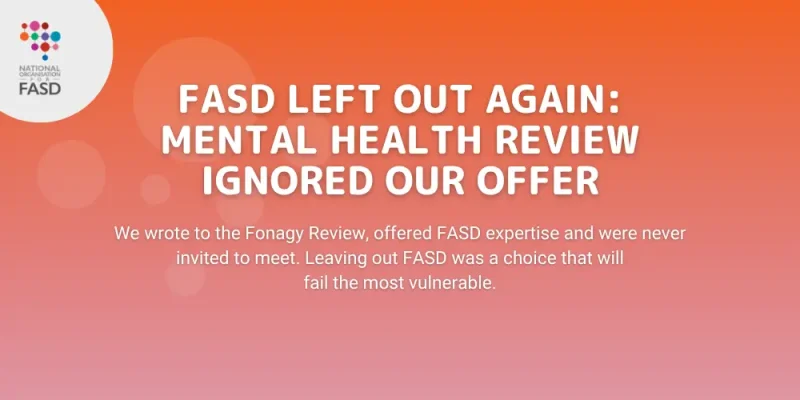
The mental health, ADHD and autism review was told about FASD, offered expert help and still left it out. That was a choice, and it will cost lives and money.
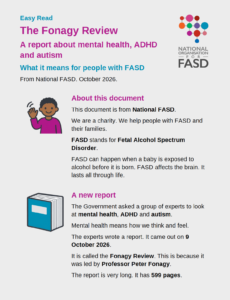
Click here for an Easy Read version
9 October 2026, 9:45 am – Today the Department of Health and Social Care published the final report of the Independent Review into prevalence and support for mental health conditions, ADHD and autism. The Government has already said the report will shape its forthcoming Mental Health Strategy. The report runs to 599 pages, with a further 230-page technical annex. In all those pages, Fetal Alcohol Spectrum Disorder (FASD) is not mentioned once. Prenatal alcohol exposure, the cause of FASD, gets half a sentence on page 418, and no recommendation follows from it. In a report this long, about these conditions, that is not acceptable.
FASD is a lifelong, brain-based condition caused by alcohol exposure in the womb. As many as 2–4% of people may have FASD, which is a higher rate than autism. That means an estimated 1.4–2.8 million people in the UK, and most of them are undiagnosed. Many are already in mental health, ADHD and autism services, often given the wrong label. They are the people for whom standard approaches are not working. FASD is especially common among care-experienced, excluded and justice-involved young people, who are exactly the groups this Review was set up to help.
This was a deliberate choice, not an oversight. On 21 January 2026, soon after the Review began, National FASD wrote to Professors Fonagy, Baird and Wessely. We copied in Professor Raja Mukherjee, who leads the national FASD service. We explained how much FASD overlaps with ADHD, autism and mental health conditions. We asked for a meeting and offered to bring together leading clinicians, people with FASD and their families. Professor Baird served with us on the NICE committee that developed Quality Standard 204 on FASD. The Review’s secretariat replied that every expression of interest was being “read carefully”. We were never invited to meet the Review. FASD was then left out of the interim report. When Lord Adebowale asked in Parliament whether the final report would address FASD, the Government replied that “it is for the chair and vice chairs to determine the specific issues the review considers”. The Review was told about FASD, offered expert help and asked about it in Parliament. It still chose to leave FASD out.
This is part of a wider pattern of silence. Our Cost of Inaction report analysed 8,565 Hansard entries on neurodevelopmental conditions. Autism appeared 6,148 times and ADHD 1,953 times, but FASD only 464 times. Autism is mentioned more than 13 times as often as FASD. The Fonagy Review adds to this silence on one of the country’s major public health challenges. That challenge has been recognised by the Department of Health and Social Care in its FASD Health Needs Assessment, by Public Health England, by NICE in Quality Standard 204, and by SIGN in its guideline SIGN 156.
The silence is costly. The Review recommends support based on need rather than diagnosis. That will only work if professionals can recognise what lies behind those needs. If prenatal alcohol exposure is not routinely considered, people with FASD will keep getting the wrong help. Our Cost of Inaction report estimates that FASD already costs UK society around £9.2 billion a year, and around £160 billion over 30 years. Much of that money is spent too late, at crisis point and in the wrong places. Our Not Commissioned report found that NHS bodies have been slow, non-strategic and uncoordinated in putting NICE Quality Standard 204 on FASD into practice.
Sandra Butcher, Chief Executive of National FASD, said:
“Nearly 600 pages, and FASD does not appear once. That is not a blind spot. We wrote to the Review at the very start, offered our help, and offered to bring in the country’s leading FASD clinicians and people with lived experience. We were never invited to meet them. They chose not to look. Leaving out FASD means leaving out one of the largest groups of people in these services, and one of the groups most often failed by them. If that choice is carried into the Mental Health Strategy, the reforms will fail to have the impact they intend. The cost will be paid by the very people they are meant to help. It is still not too late to fix this.”
We call on everyone working on the Government’s response and the forthcoming Mental Health Strategy to consult FASD experts and people with lived experience of FASD now. More than 60 people with FASD helped write the UK FASD Manifesto. Their message to decision-makers is simple: “Listen to us.”
Ends
Notes to editors
- Independent review into mental health conditions, ADHD and autism: final report (UK): https://www.gov.uk/government/publications/independent-review-into-mental-health-conditions-adhd-and-autism-final-report
- The only reference to prenatal alcohol exposure is on page 418 of the final report: “Ensure that relevant information – such as prenatal alcohol exposure and very preterm birth – can inform later assessment where appropriate.”
- National FASD policy brief, FASD Cannot Be Ignored (April 2026): https://nationalfasd.org.uk/fasd-cannot-be-ignored/
- Policy brief (PDF): https://nationalfasd.org.uk/wp-content/uploads/2026/04/Policy-Brief-Impact-of-Failing-to-include-FASD-Independent-Review-2.pdf
- The Cost of Inaction on FASD (June 2026), including the Hansard analysis on page 47: https://nationalfasd.org.uk/the-cost-of-inaction-on-fasd/
- Not Commissioned: Systemic confusion in NHS services for alcohol, pregnancy and FASD: https://nationalfasd.org.uk/not-commissioned-report/
- The UK FASD Manifesto: https://nationalfasd.org.uk/the-uk-fasd-manifesto/
- Call for FASD action from more than 100 experts (June 2025): https://nationalfasd.org.uk/100_call_for_fasd_action/
People with FASD have a right to be heard
A core principle of the UK FASD Manifesto, written with input from more than 60 people with FASD says: “Treat us with the same respect as others,” and “Listen to us.”
This Review into Mental Health Conditions, ADHD and Autism has done neither.
National FASD's policy brief explored what's at stake and why this is important
Key points from our April 2026 policy brief:
FASD is more common than autism and is heavily over‑represented among care‑experienced, traumatized, justice‑involved young people and those with extensive school exclusion histories.
Yet, FASD is rarely diagnosed and is often mislabelled as ADHD, autism, “behavioural problems” or attachment issues. A sizeable fraction of those presenting with “complex ADHD”, “complex autism”, emotional dysregulation or multiple psychiatric diagnoses have underlying FASD. Even when it is diagnosed, appropriate professionals are unaware of the import of that diagnosis. In fact, failure to recognise and address FASD can increase risk for mental health challenges among some of society’s most vulnerable.
Ignoring FASD means that a biologically driven, preventable contributor to ADHD‑ and autism‑like presentations is left out of the explanatory framework, and the highest‑need subgroup inside today’s ADHD/autism/mental health caseloads is treated as invisible.
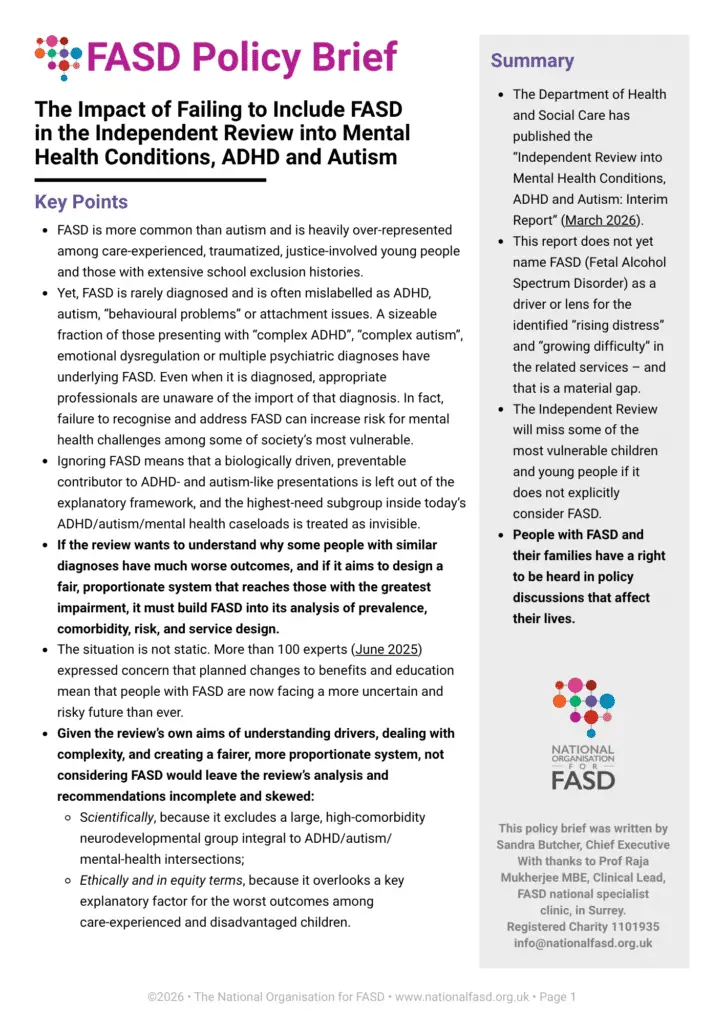
The situation is not static. More than 100 experts (June 2025) expressed concern that planned changes to benefits and education mean that people with FASD are now facing a more uncertain and risky future than ever.
Not considering FASD leaves the review’s analysis and recommendations incomplete and skewed
Scientifically, because it excludes a large, high‑comorbidity neurodevelopmental group integral to ADHD/autism/ mental‑health intersections;
Ethically and in equity terms, because it overlooks a key explanatory factor for the worst outcomes among care‑experienced and disadvantaged children.
Why that matters
Dimension | Review focus | What FASD evidence adds | Why omission matters |
Scope | Prevalence and support for mental health, ADHD, autism | FASD is common, with prevalence rate higher than autism | A major neurodevelopmental condition is absent |
Drivers of rising diagnoses | Distress, awareness, thresholds, service pressures | Prenatal alcohol exposure as an aetiological driver for some cases | Misses preventable, biologically rooted contributors |
Comorbidity | Plans to look at multiple conditions in next phase | FASD commonly co‑occurs with ADHD, ASD, mental illness | High‑need subgroup inside cohorts is unrecognised |
Equity focus | Children, young people, those out of education/work | FASD concentrated in care‑experienced and justice‑involved groups | Most vulnerable children fall through analytic and policy gaps |
System design | Earlier, better‑matched, proportionate support | FASD requires adapted assessment, formulation and intervention | Risk of designing pathways that don’t work for those with FASD |