Your stories are powerful and have made a difference
More than 250 people with FASD, families and professionals took the time to share lived experience through National FASD’s recent survey, and that generosity has made a real difference. Once again, your stories have strengthened the case we are putting forward in corridors of power for a more understanding, more joined-up and more hopeful system for children and young people with FASD.
Every response helped show not only where systems are still falling short, but also what better support can look like when services listen, adapt and work with families. Important evidence submitted from National FASD so far this year to key consultations has been rooted in that collective insight.
We have received such powerful feedback – please know the below is just the beginning. We will continue to use the experiences and insights you have recently shared to push for the change that is so very needed.
Your voices shape our work
The survey brought forward powerful reminders that children and young people with FASD need understanding, not assumptions. One parent said, “Please see the child that can’t rather than the child that is not willing.” Another contributor wrote, “No one understands FASD! Not enough known about FASD in schools.”
Families also made clear that one-size-fits-all support does not work. As one adult with FASD explained, “I would need individual support that takes into account my FASD rather than the same plan for everyone with special needs,” while another family warned, “One solution will never fit all. Kids will fall through the system.”
National FASD’s submissions highlighted calls from people with FASD themselves as well, who have asked via the UK FASD Manifesto that professionals “listen to us”, “learn more about FASD”, “never give up on us” and “help us to shine brighter”, alongside the reminder that “just because you can’t see our disability doesn’t mean we don’t have one.” We also drew attention once again to the warning from 100 experts and people with lived experience that, “planned changes to benefits and education mean that people with FASD are now facing a more uncertain and risky future than ever.”
Alongside the challenges, the survey responses highlighted what all who support people with FASD know – the strengths, talents and potential of people with FASD deserve to be recognised. These strengths are the starting point for lasting change and positive futures.
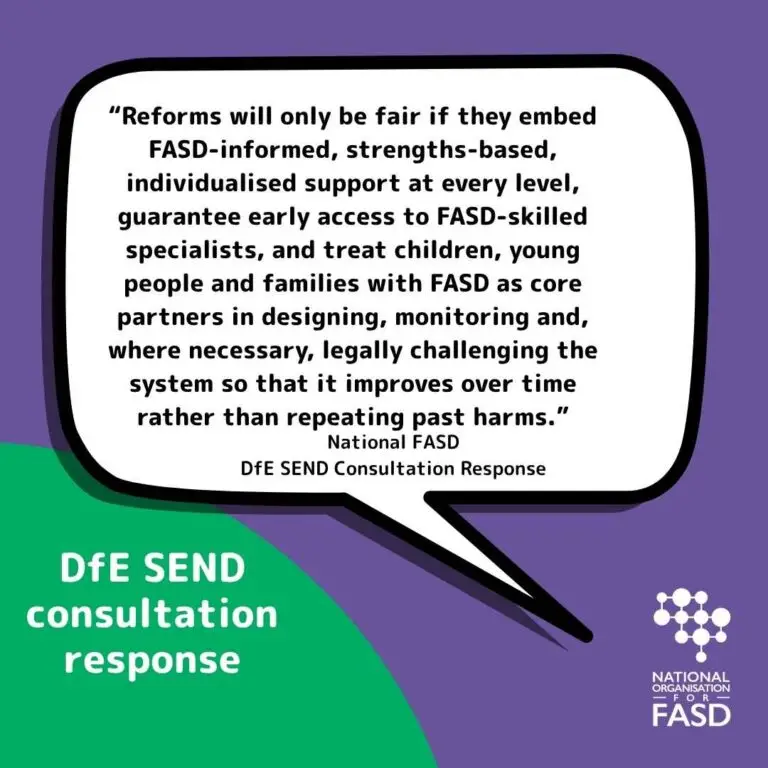
Your insights informed the DfE SEND consultation
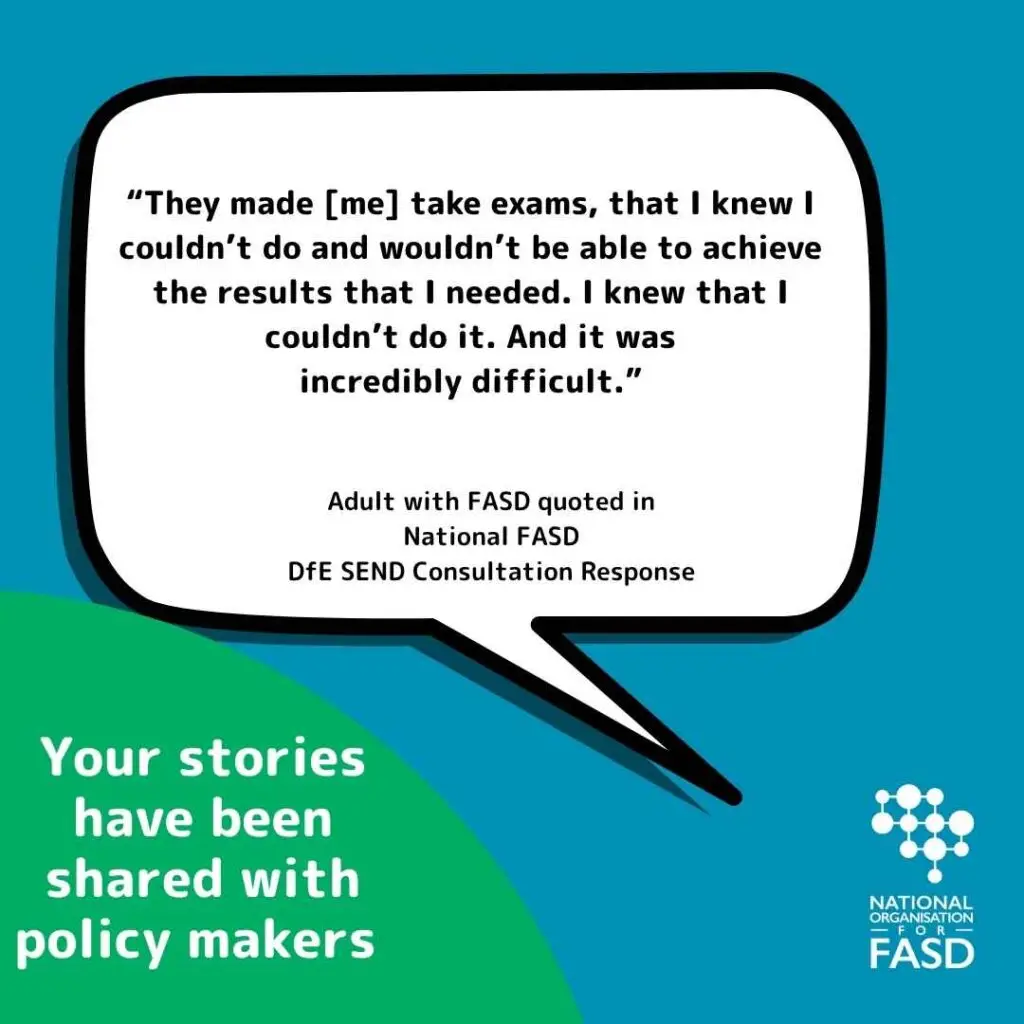
Thanks to you, National FASD’s response to the DfE SEND consultation was explicitly informed by recent feedback from more than 250 people with FASD, families and professionals. That evidence helped underline a positive but firm message: reform can only succeed if FASD is clearly recognised, support is personalised, and mainstream settings are made more inclusive and flexible.
Key points raised included the need to name FASD alongside autism, ADHD and mental health; ensure support is designed around individual profiles rather than preset packages; guarantee early access to FASD-informed specialists and diagnosis; create more flexible behaviour, attendance and assessment approaches; and preserve families’ legal routes when systems fail. The response also stressed that inclusion works best when schools value strengths, prepare peers to welcome neurodiversity, and help children and young people with SEND become self-advocates. Our SEND consultation response noted that many learners with FASD have strengths in creativity, practical and vocational skills, verbal expression, empathy and perseverance, and that education systems should build on those strengths rather than viewing FASD only through a deficit lens.
Your responses informed the DfE medical conditions at school consultation
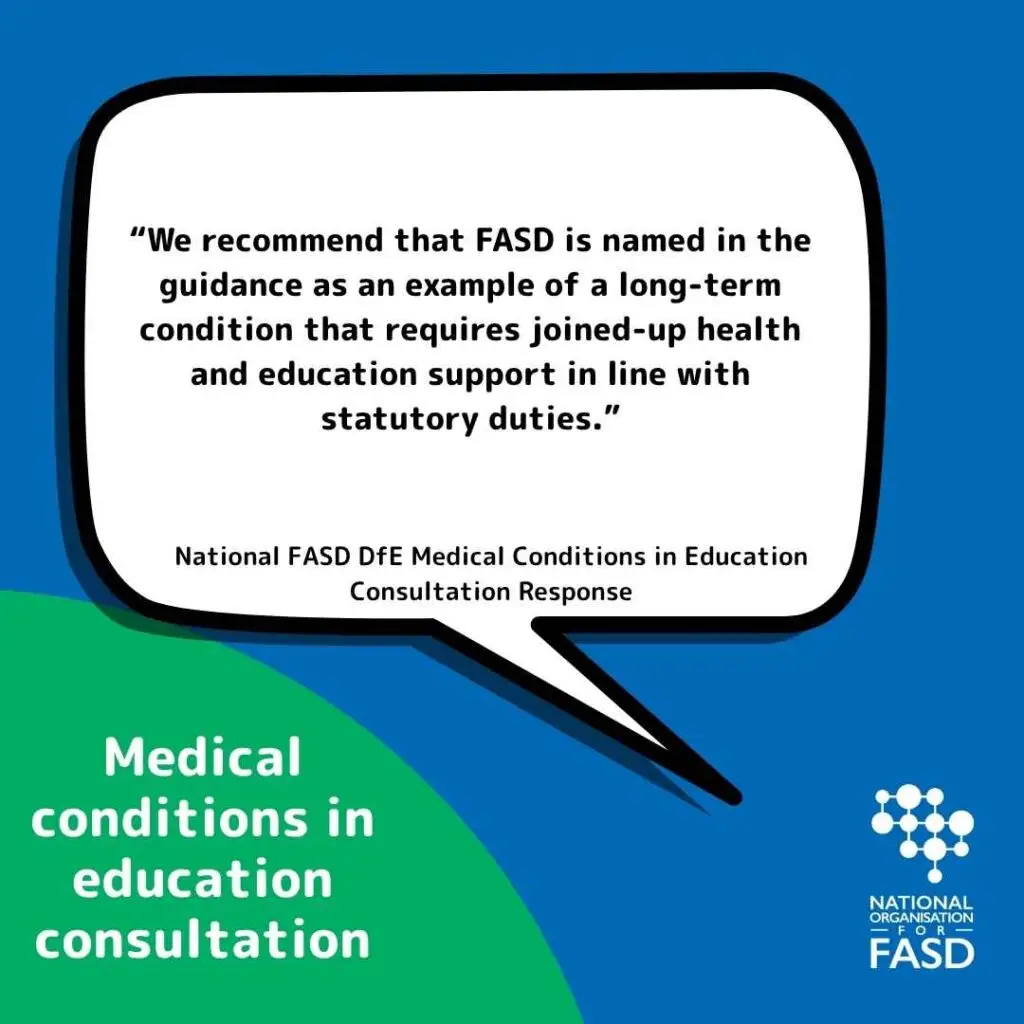
The medical conditions in education response also drew directly on feedback we received from people with FASD, families and professionals and called for a stronger, more joined-up understanding of FASD as a lifelong medical and neurodevelopmental condition. The central message was encouraging and constructive: good guidance can do even more if it clearly connects health, learning and wellbeing.
Key points included: explicitly naming FASD in the guidance, improving staff training on FASD, using needs-led Individual Healthcare Plans even where diagnosis for FASD is delayed, linking medical conditions policies with mental health and SEND practice, reviewing serious incidents involving those with FASD or suspected FASD through a health-informed lens, and allowing flexible attendance, exam and provision arrangements where needed. The response also emphasised the importance of including children and young people with FASD and their families in planning, with accessible and easy-read formats that support self-advocacy.
Adoption support that works for all consultation
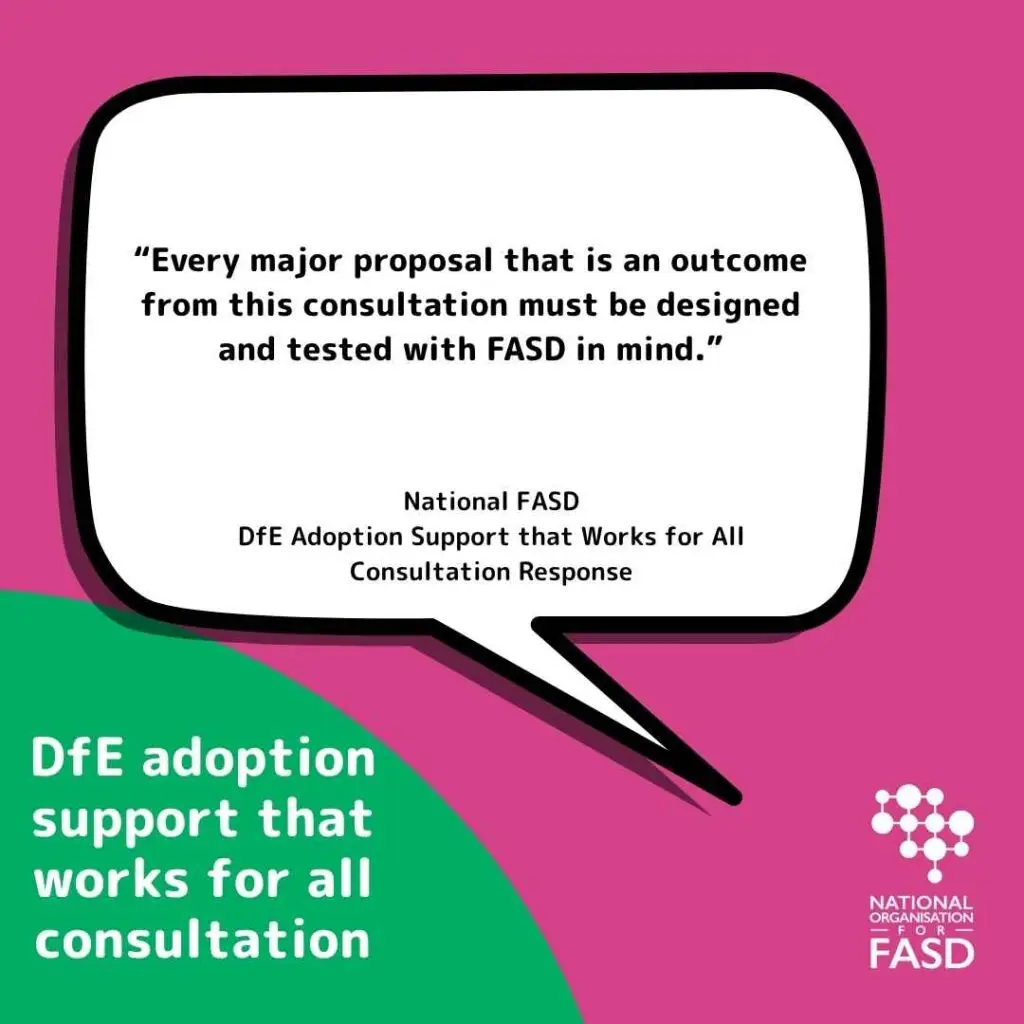
National FASD’s DfE “adoption support that works for all” submission made clear that strong support begins with a solid understanding of children’s needs and medical conditions, including FASD, which we noted is more prevalent in adopted and kinship cohorts than in the general population. It welcomed the fact that the consultation itself explicitly recognised FASD as a key driver of complex need (which was indeed a positive!) and argued that every major reform proposal should therefore be designed and tested with FASD in mind, not treated as an afterthought.
Our submission drew on the same wider message heard in the survey responses (and backed up by evidence): when FASD is recognised early and understood as a brain-based disability rather than wilful behaviour, outcomes can improve and brighter futures become more possible. It also stressed the importance of co-producing reforms with people with FASD, adoptive families and special guardians, so that policy is shaped by real experience as well as evidence.
The key points raised included building FASD-specific content into the baseline parenting offer; strengthening FASD-literate peer and community support; creating proactive FASD-informed transition support at key life stages; improving practice guides so they ask about prenatal alcohol exposure, record suspected or diagnosed FASD, and include FASD-specific adjustments; and ensuring that needs assessments include structured FASD questions, FASD-trained clinicians and referral routes into proper diagnostic pathways.
The submission also argued that effective support should align with NICE Quality Standard 204, SIGN 156 and the DHSC FASD Health Needs Assessment, and that value for money should be seen through a spend-to-save lens. It warned that without joined-up systems, families may be pushed toward substandard private diagnoses, whereas investment in FASD-informed support, tracking, training and NHS-linked pathways would make better use of public funds and help prevent avoidable crises and family breakdown.
Our response described this as a generational moment to align policy and deliver more effective, compassionate and forward-looking support, and expressed hope that recognising the importance of FASD in this consultation will lead to the systemic change that families have been calling for.
Recent policy brief on the Interim Report of the Independent Review of Mental Health Conditions, ADHD and Austim
In addition, National FASD has also recently created a policy brief highlighting how the interim review into mental health conditions, ADHD and autism is fundamentally incomplete because it fails to mention FASD at all, despite prenatal alcohol exposure being a major, preventable driver of distress, comorbidity and service demand within exactly these pathways. We said that leaving FASD out creates a material gap in the analysis and risks skewing any conclusions about what is driving rising diagnoses, how prevalence should be understood, and how services should be designed.
We emphasised research that shows that FASD is more common than autism, and is heavily concentrated among care‑experienced, justice‑involved, excluded and traumatised children and young people, yet many of those affected are instead given labels such as “complex ADHD”, “complex autism”, emotional dysregulation or multiple psychiatric diagnoses. We said that by ignoring FASD, the review overlooks a large neurodevelopmental group with very high rates of overlap with ADHD, autism and mental health conditions, and neglects a key explanation for why some people with similar diagnoses experience far worse outcomes than others. This is not just a scientific omission but an ethical and equity issue: without explicitly building FASD into its analysis of prevalence, risk and service design, the review will leave the highest‑need subgroup invisible and undermine its aim of creating a fair, proportionate and effective system
Evidence to the 0–19 workforce consultation
National FASD also provided evidence to the 0–19 workforce consultation, focused on an FASD awareness, identification and early intervention training and resource packages for health visitors and school nurses. That proposal argued that a confident, skilled universal workforce can help identify FASD earlier, support families more effectively and strengthen prevention conversations around alcohol in pregnancy.
Key points included a suggested national rollout through the Healthy Child Programme, updated expert-reviewed training, clearer referral pathways, practical resources for professionals and families, and a strong emphasis on non-judgmental communication and co-production. The proposal also highlighted that earlier identification can reduce crisis, exclusion and inappropriate pathways, helping children and families get the right support sooner.
Thank you! Your experiences matter greatly
The consultation responses and our recent policy work have been stronger because families and people with FASD were willing to speak honestly about what life is like and what needs to change. In addition to the formal submissions above, we have had meetings and emails with different departments of DfE, DHSC, NHSE, maternity teams in England and Scotland, and various ICBs.
Your lived experience has helped shape practical recommendations for a fairer system that is more informed, more compassionate and more ambitious for children and young people with FASD.
Thank you to every person who completed the survey or in other ways shared a story, highlighted a challenge or pointed to what good support looks like. Those contributions are helping move the conversation forward toward compassionate prevention, earlier identification, more personalised support, better joined-up practice and a future in which children and young people with FASD are recognised, respected and given every chance to flourish. #TogetherWeAreStronger